Adoption of AI is now common in survey research.
With the increasing AI adoption rate, ethical issues are also rising. Maintaining ethical considerations is a must for researchers who use AI in research. It will make them responsible and gain the trust of the research participants.
Let’s discuss the role of maintaining ethical considerations in using AI for research. Take a deep dive into this blog.
Consent and data privacy
AI-driven research demands data on a massive scale. But the data should be submitted to AI after the due consent from the respondents. Layers of data protection should be set too high for this. However, in reality, most researchers feel stress to maintain this.
To manage consent and data privacy, there are policies that researchers should maintain.
Before collecting data from participants, researchers should clearly speak about how their data will be handled for the research. The explanation should be free from all kinds of jargon. Besides the usage of data, the explanation must mention where the data will be stored and how the data will be shared.
You don’t need to take paper and collect signs from your respondents. Nowadays, everything is getting done via the AI-powered survey tools. These tools come with automatic data masking facilities that anonymize respondents’ data for protection.
Bias and fairness
Always remember one thing: “AI systems are technically unbiased, but they can generate biased results”. It completely depends on the training you provide to your AI systems. If you provide unbiased training, then you can expect unbiased results or otherwise, no.
AI systems basically replicate the original data or training datasets. That’s why it is particularly important to take close consideration when using data of a diverse population. Take a special interest in making the datasets free from all biases. Because keeping data inaccurate will lead to inaccurate and inadequate findings.
Test your AI model before you deploy it for your research work. Identify and correct your biases (if there are any) before you put them into your research. If you consider one step ahead, you can initiate human validation processing to ensure the data flows accurately through.
Transparency and accountability
Transparency of your research process builds trust among your respondents. If you remain transparent throughout, you can collect better and honest responses. Keeping your system closed can make your respondents vulnerable and uneasy about sharing their opinions.
You need to explain the technology and how it’s going to be applied to your system. It also means you need to document everything. Every step from collection to data analysis, the role AI plays in every step should be defined with sharp findings. Think of involving a section dedicated to “AI methodology”. This would make your research report wholesome.
📌 Another important thing. Researchers should also maintain accountability of their teams. Their team may involve people from the research design and data review process. All these people should work completely aligned. Consider ethical checks in your research workflow. You can bring it to every layer of your research method. This will also reduce the friction between your teams.
Human oversight and ethical judgments
Humans can miss some underlying patterns, but AI cannot. And that’s become extensively vital to note.
AI can bring extraordinary supervision into the research process. If you have the mindset that AI will replace the entire research process and everything, you’re thinking negatively. AI will not replace the system, but it will complement your research process. AI requires human supervision in various contexts, especially when it comes to handling or interpreting sensitive and complex research findings.
💡 Suppose your AI system found some extensive negative sentiments as research responses. Your system can define the sentiment as negative in your research findings. But when human insights get involved in the process, they will try to understand the root cause of the sentiment.
In essence, even though AI can operate research functions without human assistance, human researchers are still required to contextualize the research findings. Moreover, insights from AI systems are helpful but not a sole measure for taking actions.
Evolving role of AI in research
AI is currently in its growing age. The development and integration of AI into research and all other spheres are growing rapidly. They are all moving towards providing personalized experiences and developing real-time insights.
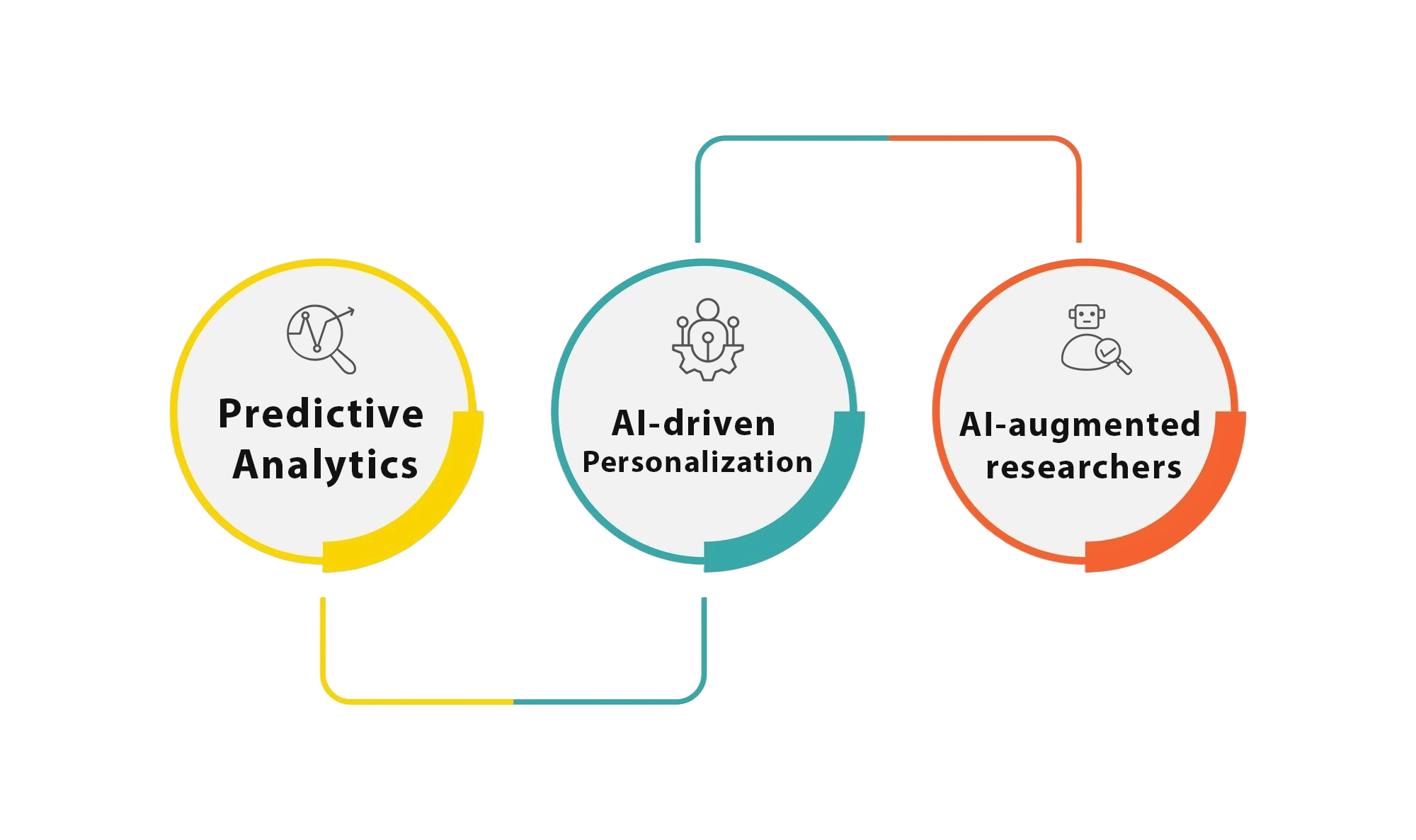
Some of the major developments that AI will take over in the coming years are;
Predictive Analytics
Understanding what will happen next at present is called prediction. In prediction analytics, the AI system can predict future trends and contexts well in advance. This system continuously analyzes market dynamics to make predictions. In research, predictive analytics can make quick pivots, validate collected information faster, and develop better strategies to mitigate future challenges.
AI-driven Personalization
Hyper-personalization is the current marketing trend. AI is bringing excellence to this matter. In research, surveys are getting customized in real-time based on the respondents’ attitudes and behavior. AI is making the survey responses more interesting and more fun, along with increasing response quality.
AI-augmented researchers
While researchers put human excellence into the entire research process, let AI assist researchers from scratch. AI-enabled research is now popular, where researchers use AI tools for various research functions. It includes data collection, data cleaning, hypothesis development, and other tasks.
In the world of research, the rate of AI adoption is high ⬆. And it has increased recently as the development of AI for research is at its peak. Researchers use AI tools for various research purposes. This includes an automated literature review process, verifying input information, adding relevant content to research papers, and more.
To realize the excellence of AI research, you must start by processing your research data with context.