In This Article
95% users of private cloud admit and report that “something is wrong” with their system. The data is not ours; Gartner reported that when studying cloud security concerns.
Private clouds offer lucrative benefits, and that is the most common attraction point for adopting private clouds. Also, private clouds are easy to deploy and administer. You can have complete agility through this system. However, to have private clouds, you need to adopt organizational changes and technical expertise. That’s where most of the companies suffer.
We are going to detail everything that causes private clouds to fail in this blog. We aim here to provide you with some tips that can save your private cloud from failing.
Shall we proceed?
First, check for infrastructure requirements
Most of the businesses realize this too late, that private clouds demand strong systems. Meaning, it requires fast processors, a strong portion of storage, backups, and a reliable internet connection. If you try adopting a private cloud using your old hardware, it simply won’t support that. It’ll be like playing an advanced game on your 15-year-old computer. Most probably, your computer won’t run the game at all!
Having an updated system is non-negotiable when you’re creating private clouds. Otherwise, you can expect the following things to happen within your systems 👇;

Slowdown
System inadequacy freezes private cloud installations. It slows down the process and sometimes crashes if high volumes of tasks are handed over.

Incompatibility
It’s obvious that old systems do not support newer versions. Private clouds require updated systems and equipment. Make sure your systems are updated.

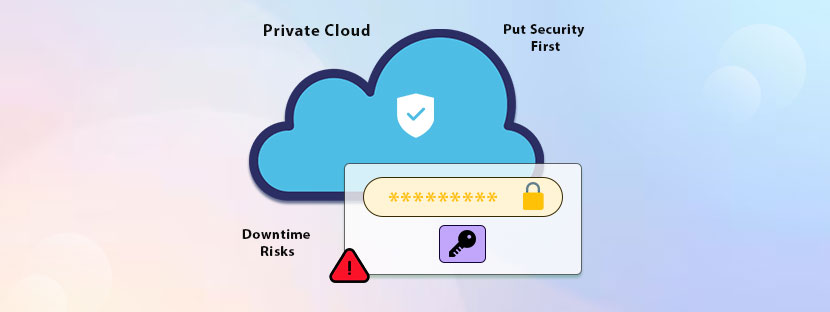
Downtime risks
Having a backup system is non-negotiable when you create a private cloud. A lack of backup may lead to data loss, legal trouble, and hurt customer trust. Consider downtime risks before making any further decisions.
↪ How to fulfill system requirements
Deploy reliable and modern equipment that can provide you with multitasking support. Even if one part fails, the other parts will take over to make the tasks happen. Apart from that, setting up multiple data backups can protect your data in many layers. If required, you can get data migration support from a third-party or outsourcing vendor. They can provide you with the right kind of support that you need for adopting a private cloud.
Top mistakes most leaders make, but you need to avoid
At present, we’ve witnessed many cloud system failure incidents across all parts of the world. A shutdown for a few minutes can incur a huge loss in many sectors of business. A complete reliance on a third party for cloud services is not a justified idea at all.
For a backup or full-fledged use, many organizations prefer creating a private cloud. But when adopting such systems, data leaders often make some basic mistakes. We’re going to discuss them in the following sections, so you can avoid making such mistakes.
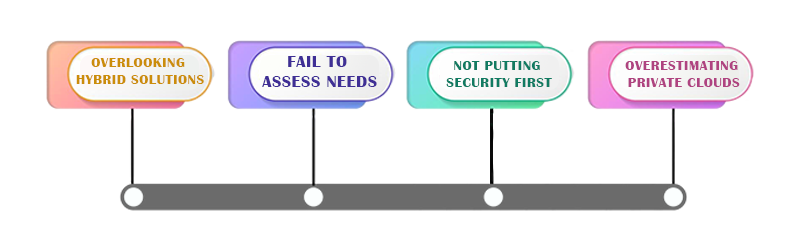
Overlooking hybrid solutions
Every application you work with is not compatible enough for the cloud. Shifting the entire infrastructure to the cloud at the same time is not a good idea to start off. But it is the most common practice that many organizations are presently doing.
Sometimes, some applications that run smoothly on legacy systems are unable to perform optimally in cloud systems. These systems create various types of IT issues that make them unsuitable for cloud deployments.
🚫 Do not overlook any of these issues at all. Often, leaders make mistakes, undermining the hybrid solutions. Checking compatibility should be there at every level before adopting any private cloud ecosystem.
Fail to assess needs
Before adopting any private cloud system, you need to assess your needs first. The entire migration journey should be well-documented in order to solve problems quickly if issues arise later. To have the benefits of a full-fledged private cloud, you need to craft a well-documented plan.
At first, figure out what you want to do with the private cloud. Also, the way you’ll going to put information into the system matters here. Whether you’re going to build a system or move your existing system to a new private cloud, assess the needs first. Many times, private cloud migration suffers due to poor planning and not identifying the exact needs.
Not putting security first
Even the strongest of cloud platforms are sometimes unable to provide enough security for data. When it comes to private cloud platforms, security must act first. Hackers can take advantage of your private cloud if you ever compromise your network. Any breach of security can undermine your migration plan at risk.
Data breaches can become highly risky if your service verticals lie in the medical or finance industries. Ensuring complete security overnight is a challenge, but you can ensure it gradually over months. For that, you need a strong security-adoption plan. Before you deploy your strategic private cloud to your organization, you should have a detailed knowledge of the security provisions mentioned in the SLAs (Service Level Agreements).
Overestimating private clouds
Many organizations and their data leaders think that private clouds will solve all their in-built technological issues. But the truth is, adopting a private cloud cannot solve everything. Some issues still remain there. For example, all your applications cannot enter the private cloud; there are some restrictions.
💡 Alternatively, some applications are ideally suited for private cloud migration. Applications that run for a short period, for example.
As these applications run for a brief time, they may cause some occasional traffic spikes in the later phase. However, they generate a small volume of data that you can migrate quite easily.
Migrate with a solid plan & proper resources
Shifting data from your legacy systems to a private cloud is a big deal. It all needs proper support channels and technical backups. Many organizations dedicatedly themselves to bringing external resources to minimize their data migration challenges extensively.
In many cases, it’s been found that the new type of data is not suitable against old virtual machines. Before you implement anything new, always assess the current state of your data.