
AI is capable of performing critical tasks that typically require human intelligence. In research, it has been used for learning, recognizing patterns, making strategies, and so on.
Over time, with the advanced development of machine learning, computer vision, and natural language processing (NLP), the involvement of AI technology in research has been sharply increasing.
This blog comes with aims to explore the role of AI in research strategy development. Let’s explore!
What does research strategy mean?
A “research blueprint” – a common term to describe a research strategy.
Research strategy usually comes in a structured format that connects your research questions with actionable insights. Having a good strategy is always desirable in research work. It means your strategies should align with your objectives.
Research strategies must include
↪ Research goals along with approaches to achieve them
↪ Outline of the methods deployed in the survey
↪ Tools and technology needed to collect survey data
↪ Methods to analyze and interpret survey data
Conducting a focused and reliable survey should be the aim of a balanced research strategy. Whether you’re researching to understand the market or customer behavior, or for academic research, structured research strategies universally perform better.
How AI is changing common research strategies
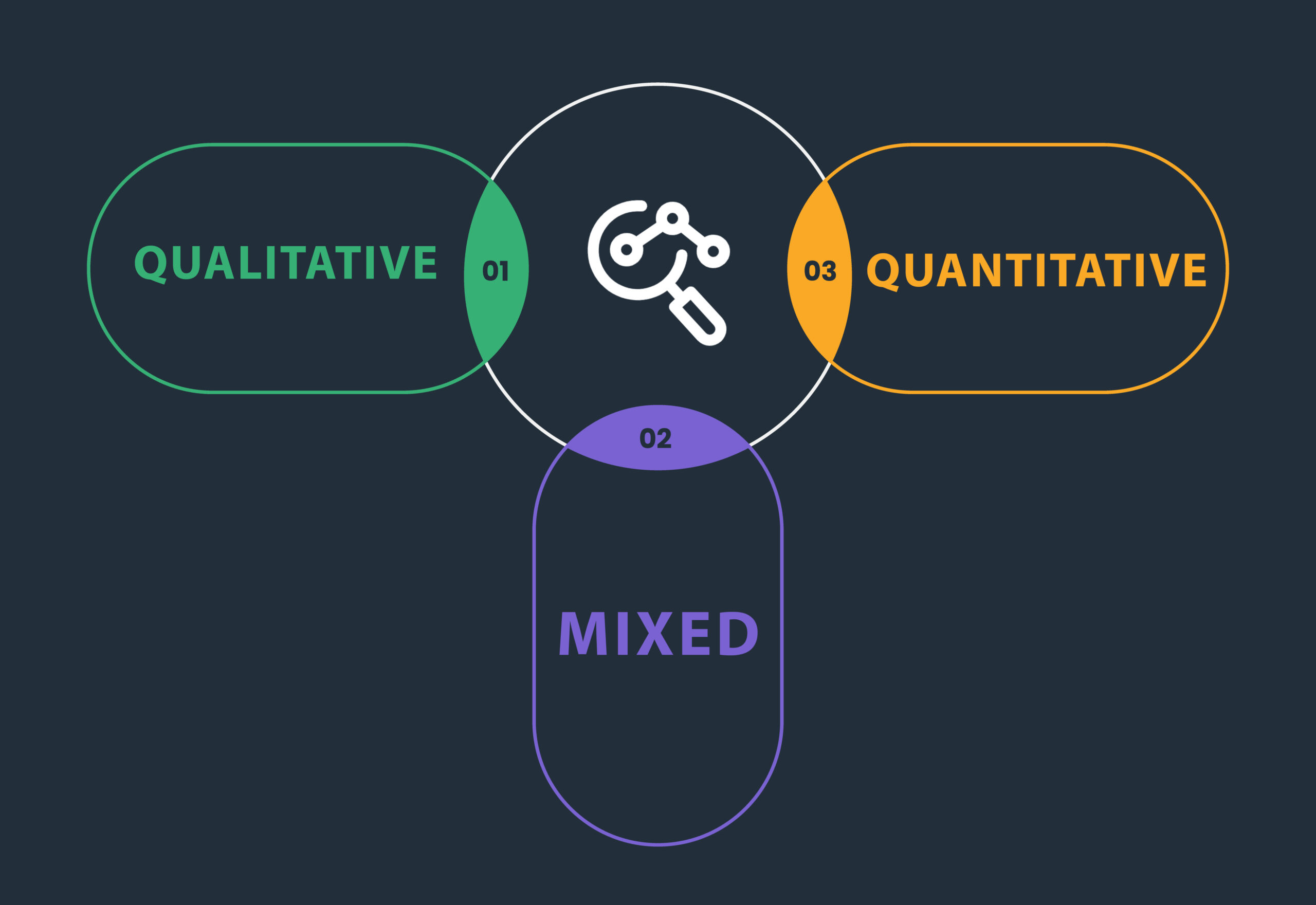
A brief understanding of these methods can help adopt AI smoothly. All these methods remain intact when AI is implemented. AI takes over time-consuming tasks and automates them. Sometimes AI acts extraordinarily well, discovering hidden patterns in data. These are the primary reasons why AI is being massively integrated into research strategies.
Let’s talk about each of these common research strategies to understand how AI performs its functions.
Qualitative Research
Understanding the “core intent” behind any phenomenon is the main concern of qualitative research. Conducting interviews, ethnographic studies, case study assessments, etc, are the common techniques of qualitative research.
Implementing AI into qualitative research not only speeds up the process but also enhances the depth of the research. It can accurately interpret and analyze complex data. See how AI is helping in qualitative research.

Transcription & Interview Assessment
Convert spoken words into texts with a higher accuracy rate. Make the interview process super-fast and efficient.

Sentiment Assessment of Text
AI-enabled sentiment assessment tools automatically assess human emotions. It identifies underlying attitudes and feelings.

Pattern Recognition of Unstructured Data
Identify trends and patterns across your unstructured databases. For example, video transcripts, open-ended surveys, video recordings, etc.

Real-time Feedback Assessment
AI provides instant delivery of insights that reduces the research timeline and brings faster decision-making.
Quantitative Research
Collecting structured numerical and factual data is the primary aim of quantitative research. This research focuses on subjective experiences. So, the common research methods under this research include experimental studies, hypothesis testing, statistical assessments, mathematical modeling, etc.
Involvement of AI in quantitative research has massively increased the speed and sophistication of data analysis. Let’s check where AI is taking a dominating role.
⟢ Automated Data Collection: Involving AI in quantitative research empowers machines to collect data from diverse sources. Collect data from surveys in a recoded speed and scale.
⟢ Data Analysis at Massive Scale: Bring on real-time assessment of data at a massive scale. AI can handle vast sets of data with accurate speed and precision. Millions of datasets or even billions, processing data at a massive scale doesn’t matter.
⟢ Predictive Analytics: Not just accepting data from different points, AI enables researchers to forecast common outcomes and trends. It is suitable for strategic decisions and valuable insights.
⟢ Real-time Data Processing: AI tools enable real-time data processing. It allows researchers to dedicate more time to making conclusions from the research findings.
Bringing AI into the research workflow
It’s 2026 ⏳. You’re missing out on many exclusive benefits if you still not yet using AI systems in survey research. Whether you’re using AI for qualitative or quantitative, it will streamline your survey procedure at the optimal level.
Adopting AI for developing survey strategies is a lengthy process. It will need time and focus. Let’s now see how you can bring AI into the research workflow gradually over time.
➣ Plan your research with AI
Laid out a successful plan for your research project, along with defining all the research objects, questions, and methodologies.
Putting data into AI systems can help researchers understand trends and predictions better. Besides understanding the research purpose, AI systems also offer data-driven recommendations. Nowadays, researchers use AI tools to identify research gaps in existing research, optimizing sample selection, and many other things.
🫧 If you’re new to research using AI tools, you must plan it at the beginning. There are many AI-powered tools available in the market to help you develop a research strategy and other methods.
➣ Let AI do literature review
Literature review is a standard part of the survey procedure. It ensures that your research is based on some existing knowledge, not just a random study. However, it requires an in-depth study of the entire process. Sometimes it makes the process a little laborious. And that’s when AI comes into the picture.
Plus, identifying key themes, methodologies, and finding key studies are possible using this process.
➣ Collect & Analyze data using AI
Data collection plays a hectic and major role in the research field. For detailed research, you need data from multiple fields. Earlier, skilled people used to handle the data collection parts. Nowadays, extensive data collection procedures are available for acquiring data.
You can deploy AI tools to collect the required amount of data for your research. Not only can you collect, but you can also use AI for assessing your collected datasets, too.
➣ Write & edit with AI
Besides the required survey documents, you can use AI for writing. It can help you write a clear version of the research findings if you provide the right input. Besides generating texts, you can use AI tools for summarizing, refining, and structuring your research findings.